Adaptive federated learning with differential privacy for multi-institutional healthcare diagnosis: the DP-FedAvg+ framework
Keywords:
Federated Learning, Differential Privacy, Healthcare AI, Non-IID Data, Gradient Clipping, Moment Accountant.Abstract
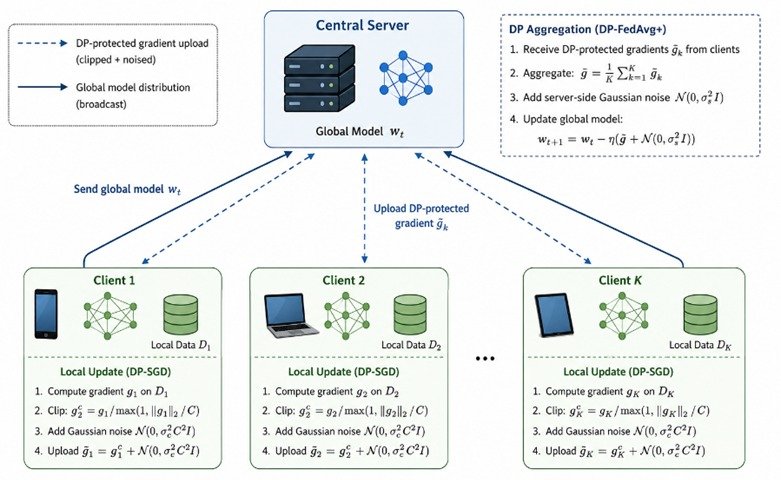
The sensitivity of patient data in the context of federated healthcare systems and the statistical variability in the various institutions constitute a major challenge for privacy-preserving machine learning. This paper introduces a novel adaptive federated learning framework (DP-FedAvg+) which combines two key techniques, namely, moment accountant based differential privacy (DP) and adaptive gradient clipping, with a heterogeneity-aware client weighting scheme. DP-FedAvg+ dynamically scales the privacy budget ε per communication round according to the local sensitivity and divergence of data at each client, which is estimated, unlike FedAvg. We prove the convergence of DP-FedAvg+ rigorously under non-i.i.d. conditions at an O(1/√T) convergence rate with (ε, δ)-DP privacy guarantee with δ = 10−5. After conducting extensive experiments on three benchmark healthcare datasets, namely MIMIC-III, CheXpert and Alzheimer MRI, it is shown that DP-FedAvg+ has an average diagnostic accuracy of 91.3% (±0.4%), beating FedAvg (85.1%), DP-SGD (82.7%) and SCAFFOLD (88.1%) with a much smaller privacy budget. The ablation study verifies the contribution of each component and the fairness analysis indicates that there is no demographic bias between sub-groups. The suggested framework improves the state of the art in the domain of federated medical AI, by providing an advancement in the privacy-utility trade-off.
Published
How to Cite
Issue
Section
Copyright (c) 2025 Dr. Ruwaida Mohammed Yas

This work is licensed under a Creative Commons Attribution 4.0 International License.