Navigating the academic labyrinth: understanding and addressing stress among undergraduate and postgraduate students in Telangana
Keywords:
Academic Stress, Mental Health, Competition, Workloads, Expectations, Transition Challenges.Abstract
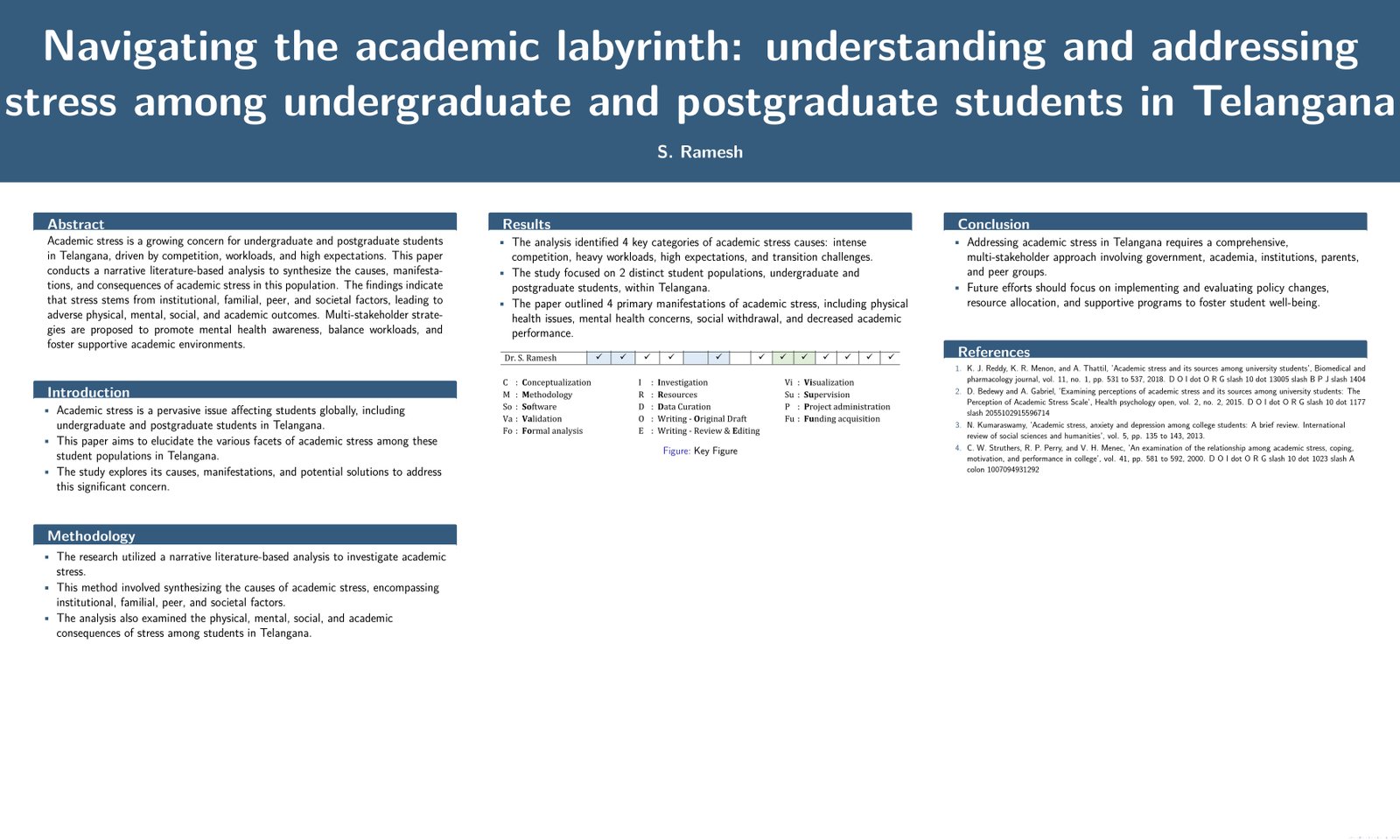
Background: Academic stress among undergraduate (UG) and postgraduate (PG) students is a growing concern, driven by intense competition, heavy workloads, high expectations, and difficult academic transitions. Objective: To examine the causes, manifestations, and consequences of academic stress among UG and PG students in Telangana, India, and to propose strategies for its management. Methods: Narrative literature-based analysis synthesizing causes of academic stress (institutional, familial, peer, and societal factors) and its physical, mental, social, and academic consequences among students in Telangana. Results: Academic stress in this population arose from competitive pressures, workload, high parental and institutional expectations, and transition difficulties (e.g., school-to-college), contributing to adverse physical and mental health outcomes, impaired social interactions, and reduced academic performance. Government, academic institutions, parents, and peer groups were identified as key stakeholders shaping stress manifestation. Conclusion: Multi-stakeholder strategies promoting mental health awareness, balancing academic workloads, encouraging healthy work-life balance, and building supportive academic environments are needed to mitigate academic stress and its downstream effects on UG and PG students.
Published
How to Cite
Issue
Section
Copyright (c) 2023 Dr. S. Ramesh

This work is licensed under a Creative Commons Attribution 4.0 International License.