Impact of socialization and financial greed in endorsing immoral decisions among students
Keywords:
Immoral Behaviour Socialization, Financial Greed, Immoral Decisions, Students Immoral Behaviour.Abstract
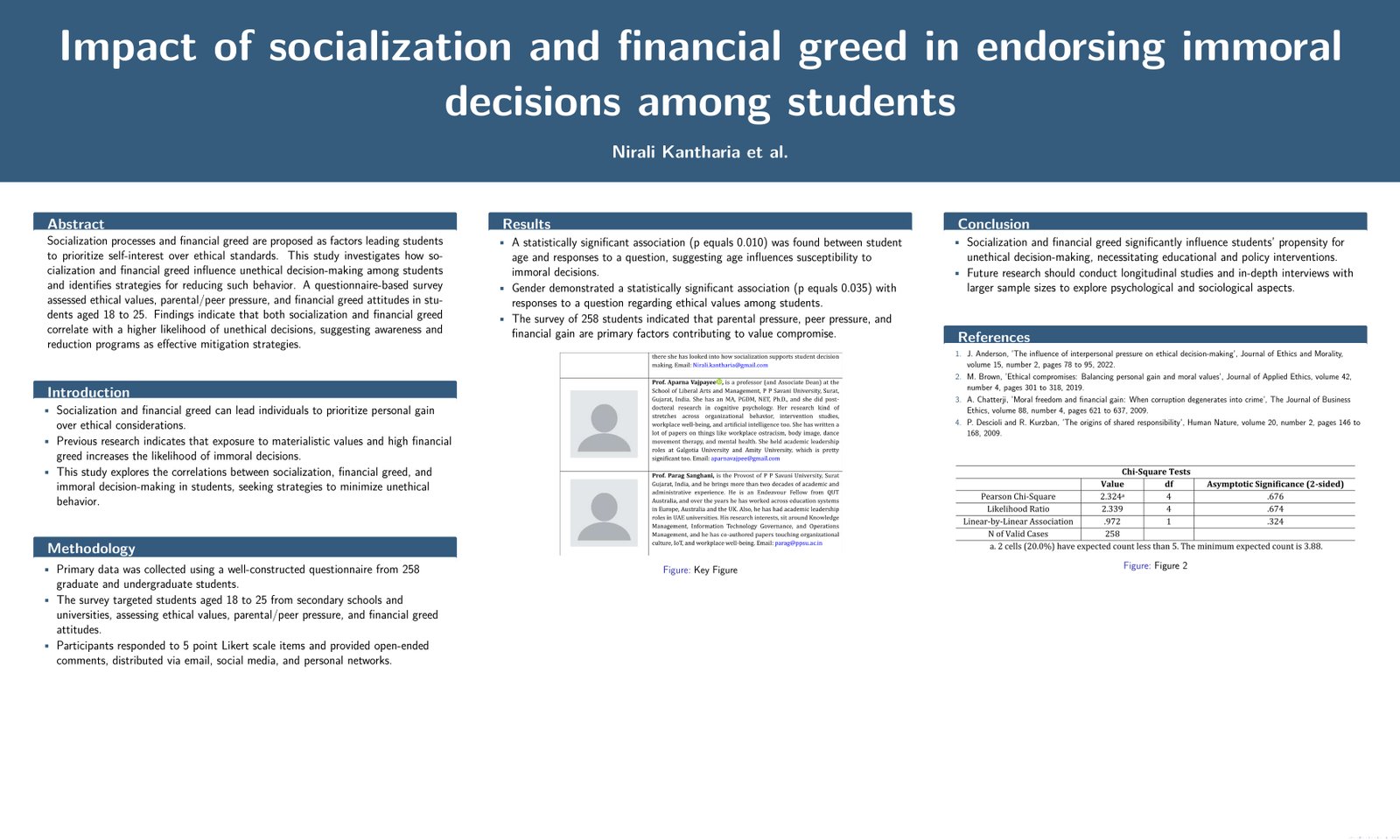
Background: Socialization processes and financial greed have been proposed as contributing factors that lead individuals, particularly students, to prioritize self-interest over shared ethical standards. Objective: To investigate the influence of socialization and financial greed on unethical decision-making among students and to identify strategies for reducing such behavior. Methods: Questionnaire-based survey of students aged 18–25 from secondary schools and universities, assessing ethical and moral values, parental and peer pressure, and financial-greed-related attitudes using 5-point Likert-scale items with open-ended comments; distributed via email, social media, and personal networks, and interpreted against existing literature. Results: Socialization (parental and peer influence) and financial greed were both associated with a greater likelihood of unethical decision-making. Students with stronger materialistic values or higher financial greed were more likely to make immoral choices for personal gain. Raising awareness of moral values and implementing programs to reduce financial greed emerged as potentially effective mitigation strategies. Conclusion: Socialization and financial greed meaningfully shape students' propensity toward unethical decision-making. Educational and policy interventions that strengthen moral awareness and reduce materialistic or greed-driven attitudes may help promote fairer, more ethical behavior among young people.
Published
How to Cite
Issue
Section
Copyright (c) 2023 Ms. Nirali Kantharia, Prof. Aparna Vajpayee, Prof. Parag Sanghani

This work is licensed under a Creative Commons Attribution 4.0 International License.