The impact of mental health on academic performance: a comprehensive examination
Keywords:
Mental Health, Academic Success, Degree Persistence, Inclusive Environment.Abstract
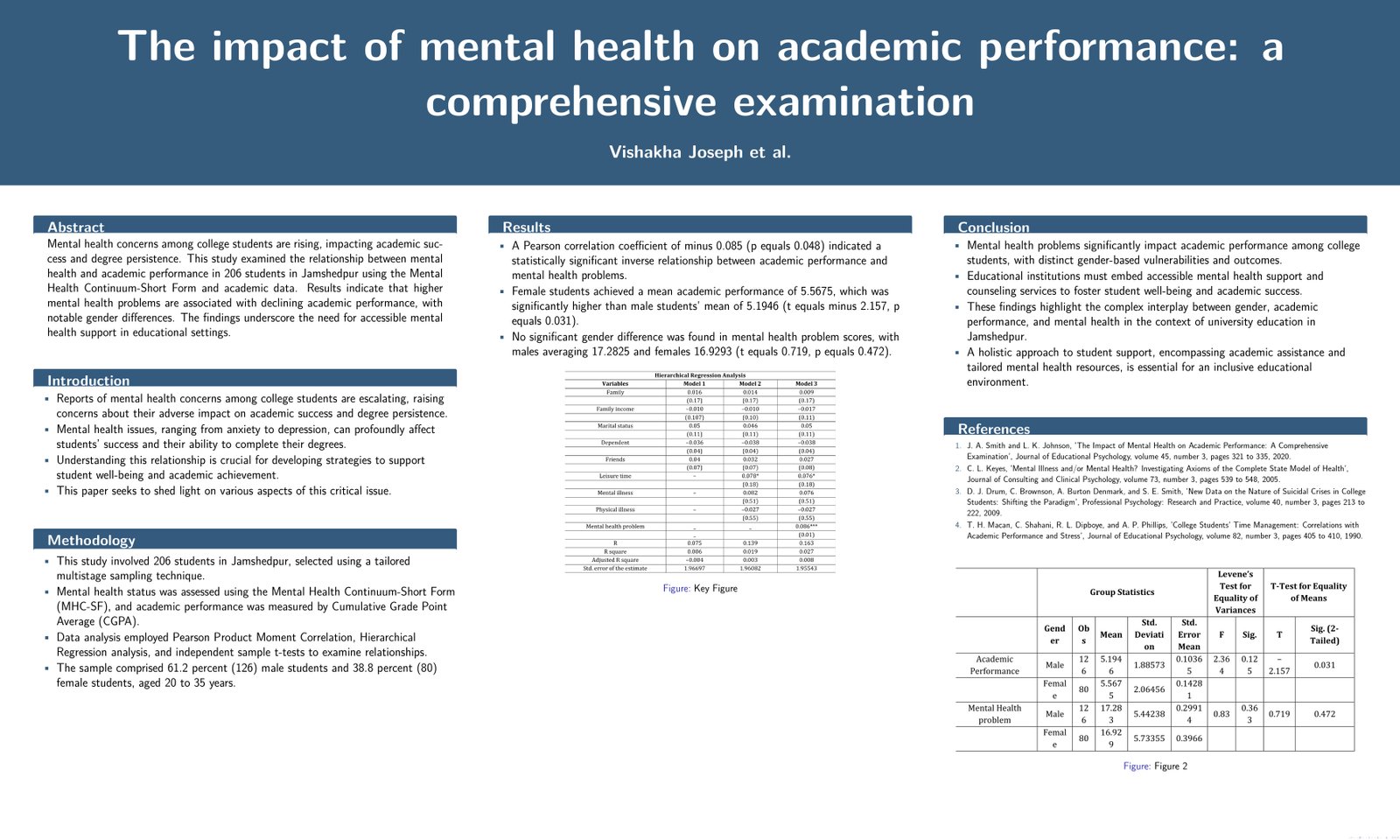
Background: Reports of mental health concerns among college students have risen, raising concerns about the adverse impact of mental illness on academic success and degree persistence, and the need for accessible, embedded support. Objective: To examine the relationship between students' mental health and academic performance in college, and to provide recommendations for embedding mental health support into educational practice. Methods: Study of 206 students in Jamshedpur using the Mental Health Continuum-Short Form (MHC-SF) to assess mental health status, combined with analysis of academic performance data; three regression models examined associations with family type, family income, number of friends, leisure time, physical illness, and number of dependents. Results: Higher mental health problems were significantly associated with declining academic performance. Female students outperformed male students academically, while male students were more susceptible to mental health problems. Family type, family income, number of friends, and leisure time were positively associated with academic performance, whereas mental health problems, physical illness, and number of dependents were negatively associated; mental illness and drug use did not show significant independent effects. Conclusion: Mental health problems substantially affect academic performance among college students, with notable gender differences in both vulnerability and outcomes. Embedding accessible mental health support and counseling services into classroom practice is essential to promote student well-being and academic success.
Published
How to Cite
Issue
Section
Copyright (c) 2023 Ms. Vishakha Joseph

This work is licensed under a Creative Commons Attribution 4.0 International License.