Diversity, abundance, and habitat suitability of small carnivores and mesopredators in the agro-pastoral landscapes of Yavatmal district, Maharashtra, India: implications for conservation planning
Keywords:
Camera Trapping, Mesopredator Release, Occupancy Modelling, Maxent, Diel Activity, Agro-Pastoral Mosaic.Abstract
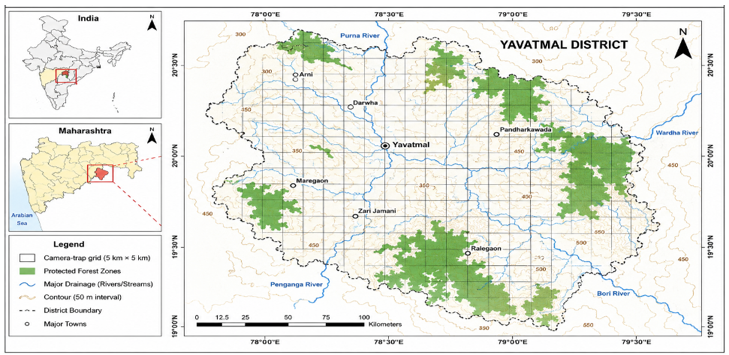
Small carnivores and mesopredators play an essential role in the functioning of terrestrial ecosystems, but are poorly studied in highly fragmented agro-pastoral landscapes with accelerated land-use change. In this study, mesopredator communities in Yavatmal District (Mumbai Division), Maharashtra were studied over a 2-year period from June 2022 to May 2024, comprising 96 camera trap stations and 8640 trap days. Five focal species were assessed: Bengal fox (Vulpes bengalensis), striped hyena (Hyaena hyaena), jungle cat (Felis chaus), small Indian mongoose (Herpestes edwardsii) and Indian hare (Lepus nigricollis). In total, 2,847 independent detections were made. The occupancy rates were 0.41 ± 0.06 for striped hyena and 0.78 ± 0.04 for small Indian mongoose. Habitat suitability modelling showed that the best predictive model was for the Bengal fox (AUC = 0.887), with particular emphasis on the importance of agricultural margins and ecotonal habitats. Activity analysis revealed that for all species, the dominant activity phase was crepuscular or nocturnal, and that there was significant temporal partitioning between the carnivore species (Δ = 0.31, p < 0.001). Species diversity, represented by the Shannon diversity index, was relatively high, and decreased significantly with distance from protected forest edges (r² = 0.61, p < 0.01) on a mean basis across sampling grids. The results would prove that the agro-pastoral landscapes of Yavatmal have a favourable mesopredator complex. It is important to enhance landscape connectivity and minimise retaliatory persecution and promote wildlife-friendly agriculture to help conserve these species. This study is the first spatially explicit baseline study of mesopredator ecology in Vidarbha and it gives important guidelines to conservation planning and sustainable land-use management.
Downloads
Published
How to Cite
Issue
Section
Copyright (c) 2026 Mr. Devendra Kumar Durgam

This work is licensed under a Creative Commons Attribution 4.0 International License.