Spatial distribution, habitat utilization, and seasonal population dynamics of mammalian fauna in agro forest ecotones of central india: a multi-year field assessment
Keywords:
Agro-Forest Ecotone, Camera Trapping, Population Dynamics, Habitat Suitability, Wildlife Corridor, MaxEnt Modelling.Abstract
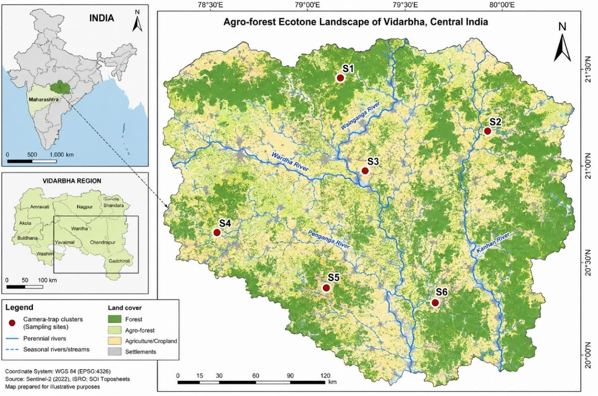
Agro-forest ecotones are a key transitional habitat in the Indian subcontinent with high mammal’s diversity, but poorly known in terms of species richness gradient and seasonal variation at the population level. In this study, a multi-year (2021-2024) comprehensive assessment of mammalian fauna was done in six study sites in agro-forest ecotones of the Vidarbha region of Central India that were stratified on the basis of habitat characteristics. We recorded 34 species, 8 orders, with the use of camera-trap grids (n = 144 stations), transect line sampling and acoustic monitoring. The Shannon Diversity Index (H') ranged from 2.14 to 3.67 at the sites, with forest dominated sites having significantly higher diversity (p < 0.001, ANOVA). Most activity occurred during the night or at dusk; the greatest activity was observed between 05:30-07:00 h and 18:00-20:00 h. Tree canopy density (>40% canopy), distance to water sources (<500 m), and proximity to crop fields were found to be the main habitat suitability modelling (MaxEnt) predictors of mammalian presence. Fluctuations between seasons were significant for four focal species (Indian leopard Panthera pardus fusca, striped hyena Hyaena hyaena, Indian crested porcupine Hystrix indica and golden jackal Canis aureus) and were related to the monsoon and agricultural cycles. The results of this study offer empirical reference points for wildlife corridors and human-wildlife conflict mitigation measures in one of the most ecologically-stressed areas in India.
Downloads
Published
How to Cite
Issue
Section
Copyright (c) 2026 Mrs. Kamleshwari Durgam

This work is licensed under a Creative Commons Attribution 4.0 International License.