Influence of emotional maturity and resilience in coping among parents of kids with autism and intellectual disability
Keywords:
Emotional Maturity, Resilience, Coping, Parents of Children with Autism, Intellectual Disability.Abstract
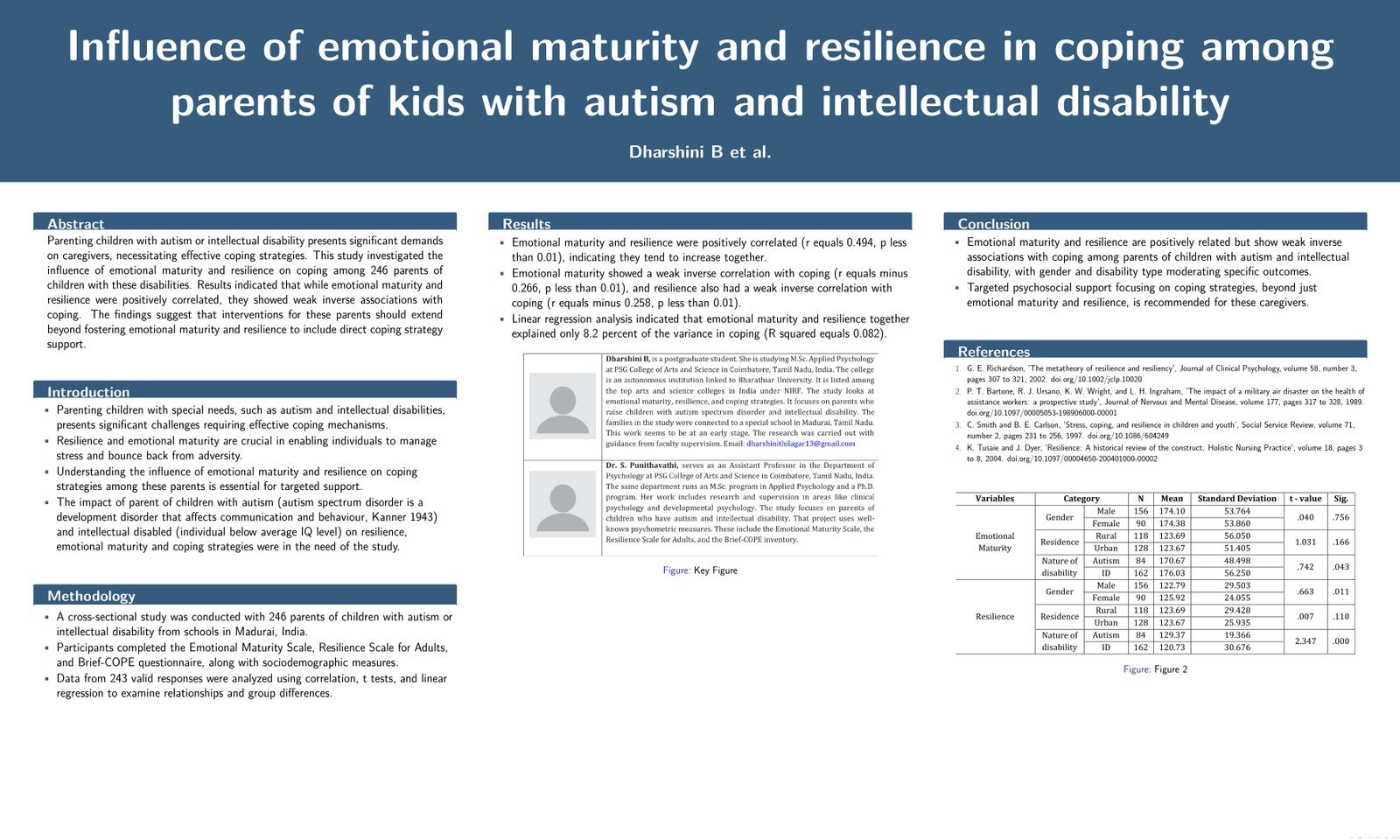
Background: Parenting a child with autism or intellectual disability represents a significant life transformation that places heightened demands on caregivers, requiring greater tolerance and effective coping strategies to manage rising expectations. Objective: To examine the influence of emotional maturity and resilience on coping, and to identify differences in emotional maturity, resilience, and coping by gender, residence, and type of child disability among parents of children with autism and intellectual disability. Methods: Cross-sectional study of 246 parents of children with autism or intellectual disability recruited from Thendral Vidyalaya School, Madurai, and nearby schools. Participants completed the Emotional Maturity Scale, Resilience Scale for Adults, and Brief-COPE questionnaire, together with sociodemographic measures; correlation, t-test, and linear regression analyses were performed on 243 valid responses (63.4% male, 52% urban; 65.9% intellectual disability, 34.1% autism). Results: Emotional maturity and resilience were significantly positively correlated (r=.494, p<0.01), while both were inversely correlated with coping (emotional maturity–coping r=-.266; resilience–coping r=-.258, p<0.01). No significant group differences emerged for emotional maturity overall, but resilience differed significantly by nature of disability (p<.001) and coping differed significantly by gender (p=.006). Linear regression indicated emotional maturity and resilience together explained minimal variance in coping (R²=.082), suggesting limited predictive effect. Conclusion: Emotional maturity and resilience are positively related to each other but show weak, inverse associations with coping among parents of children with autism and intellectual disability, and gender and disability type moderate specific outcomes. Targeted psychosocial support addressing coping strategies, beyond emotional maturity and resilience alone, is warranted for these caregivers.
Published
How to Cite
Issue
Section
Copyright (c) 2023 Dharshini B, Dr. S. Punithavathi

This work is licensed under a Creative Commons Attribution 4.0 International License.