Segmentation of soil surface roughness features using a hybrid deep learning and geostatistical framework: a multi-scale approach for precision agriculture applications
Keywords:
Soil Roughness Segmentation, Deep Learning, SAR Backscatter, Geostatistics, Fractal Dimension, Precision Agriculture.Abstract
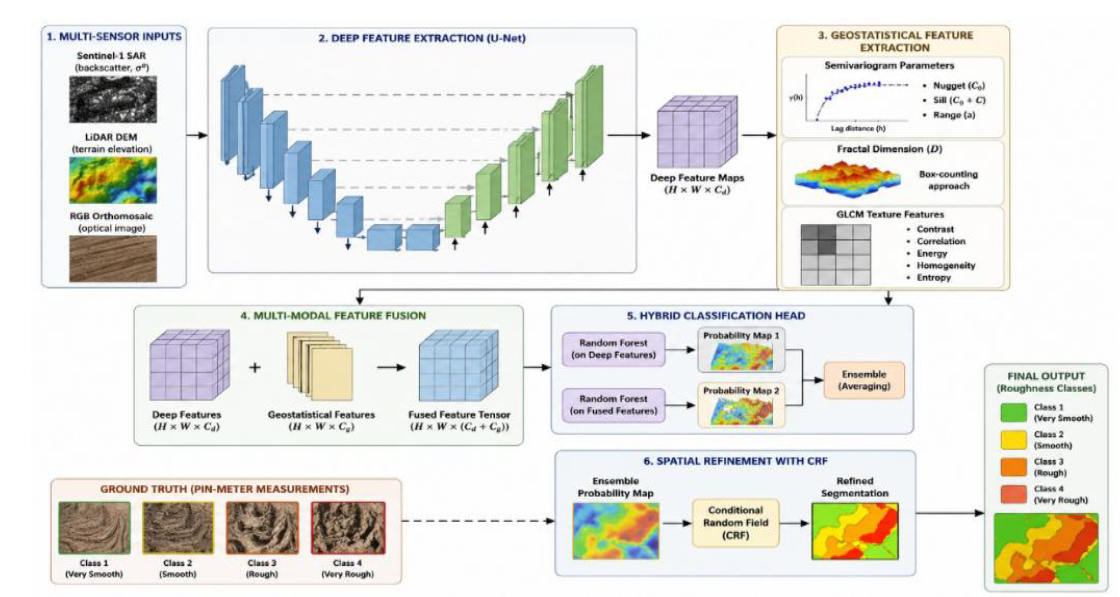
The soil surface roughness (SSR) is one of the most important parameters that affect the surface hydrology, soil erosion processes, radar backscatter characteristics and tillage management in precision agriculture. Multi-modal remote sensing imagery segmentation based on the roughness features is still an open problem of accuracy and automation due to the spatial inhomogeneity of soil surface, variation in illumination and lack of reference data sets. In this paper a novel Hybrid Deep Learning–Geostatistical (HDLG) framework for automatic multi-class segmentation of soil surface roughness features is presented. The proposed approach combines a convolutional encoder–decoder architecture, a random forest ensemble classification stage which is further enriched with geostatistical descriptors, such as semivariogram parameters and fractal dimension indices, as additional feature channels and a Conditional Random Field stage for refining the boundaries. Experiments were performed on a selected set of 480 field plots that were acquired under four different tillage methods (no-till, harrowed, chisel-plowed and moldboard-plowed) with Synthetic Aperture Radar (SAR), terrestrial LiDAR and close-range photogrammetry, covering three distinct sites geographically and texturally. Results indicated that, One-way Analysis of Variance (ANOVA) confirmed that there was a statistically significant difference among the roughness classes (F = 318.42, p < 0.0001). The proposed HDLG framework outperformed a number of baselines including standalone U-Net CNN (87.5% mIoU) and random forest (82.3% mIoU) with an overall accuracy of 95.4%, a mean Intersection over Union (mIoU) of 92.1% and an F1-score of 94.4%, which are statistically superior to the baselines (paired Wilcoxon test, p < 0.01). A high negative linear correlation between root-mean-square roughness height and the segmentation accuracy was found at a coarser roughness scale (R² = 0.891), and an ablation study showed that the geostatistical feature integration increases the segmentation accuracy by 4.6 mIoU percentage points over the deep-learning-only baseline. The framework is also evaluated across multiple sensors and sites, and under varying conditions, further confirming the generalizability of the framework to various soil moisture types, sensor modalities, and seasons, supporting its application for large-scale operational implementation in smart farming systems.
Downloads
Published
How to Cite
Issue
Section
Copyright (c) 2025 Ranjana Meshram Damle

This work is licensed under a Creative Commons Attribution 4.0 International License.