Community ecology, habitat suitability, and multi-threat assessment of mesopredator assemblages in agro-pastoral landscapes of central India: a camera-trap and MaxEnt approach
Keywords:
Camera Trapping, Mesopredator Release, Occupancy Modelling, Maxent, Temporal Partitioning, Central India.Abstract
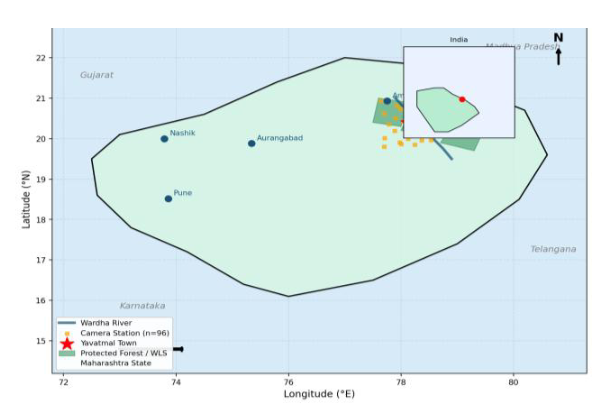
Background: Mesopredators and small carnivores undertake essential ecological roles in the tropics and their community-level dynamics in the agro-pastoral mosaics of central India have been poorly described. These ecologically important sets are under threat due to a combination of progressive loss and degradation of native vegetation, increasing livestock grazing and agricultural development in Vidarbha. Methods: The systematic camera trapping was carried out in 48 grid cells (5 km × 5 km) with 96 camera stations in Yavatmal District, Maharashtra state for the duration of June 2022 to May 2024 with 8,640 trap-nights. Five focal species (Bengal fox Vulpes bengalensis, striated hyena Hyaena hyaena, jungle cat Felis chaus, small Indian mongoose Herpestes edwardsii and Indian hare Lepus nigricollis) were used to construct single-season occupancy models (MacKenzie et al. framework), MaxEnt habitat suitability models, kernel-density diel activity estimation, and multi-threat index scoring. Results: 2,847 independent records were made. Occupancy estimates were corrected for values between 0.41 ± 0.06 (H. hyaena) and 0.78 ± 0.04 (H. edwardsii) and were significantly higher than naive estimates. Forest-agricultural ecotones had the largest AUC (0.887) value for habitat suitability for Bengal fox. There was a significant temporal partitioning between V. bengalensis and H. hyaena (Δτ = 0.31, p < 0.001). The Shannon diversity index averaged across cells was H' = 2.03, and significantly decreased with increasing distance from forest edges (r2 = 0.61; p < 0.001). Multi-threat analysis identified H. hyaena as being at the highest conservation priority. Discussion: Agro-pastoral landscape of Yavatmal has a functional significant mesopredator guild, even as the land-use change is in progress. There is a great need for evidence-informed interventions to support corridors, anti-persecution outreach, and mitigate road deaths.
Downloads
Published
How to Cite
Issue
Section
Copyright (c) 2026 Dr. Methaq Hadi Lafta

This work is licensed under a Creative Commons Attribution 4.0 International License.