Effects of moringa oleifera leaf meal supplementation on growth performance, carcass characteristics, serum biochemistry, antioxidant status, and intestinal morphology of broiler chickens
Keywords:
Moringa Oleifera, Broiler Growth Performance, Antioxidant Enzymes, Carcass Yield, Intestinal Morphology, Phytogenic Feed Additives.Abstract
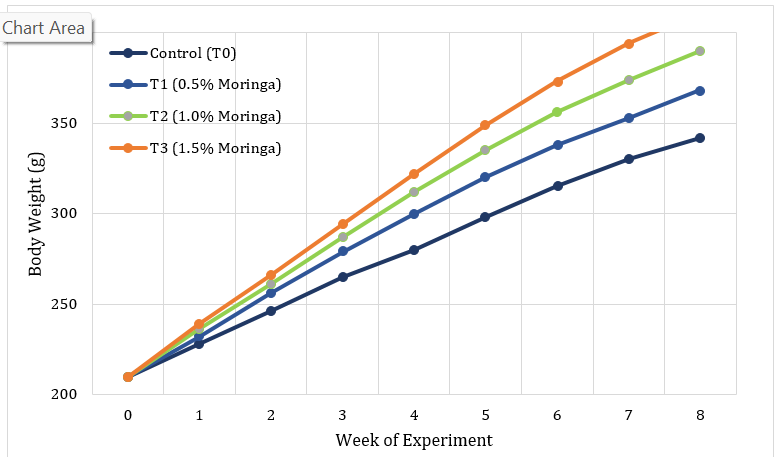
The dose dependent effect of Moringa oleifera leaf meal (MOLM) on growth performance, carcass yield, serum biochemical parameters, hepatic antioxidant enzyme activities and intestinal morphology was investigated in Cobb 500 broiler chickens. A basal control diet (T0) and diets fortified with 0.5% (T1), 1% (T2) and 1.5% MolM (T3) were fed to a total of 240 day-old chicks, equally distributed into four dietary treatments (60 chicks per treatment) with six replicates comprising 10 chicks each for 56 days. The final body weight, weight gain and breast meat yield significantly (P<0.05) increased with the increasing dose, and T3 exhibited the highest level of 410.4 g, 367.2 g weight gain and 32.3% breast meat yield, respectively. FCR was improved by the addition of MOLM in a gradual manner, starting from 1.86 in the control group to 1.53 in T3. In MOLM-fed birds, serum total protein, and albumin concentrations were raised, whereas serum cholesterol, triglycerides, and glucose concentrations were decreased. Activities of hepatic superoxide dismutase, catalase and glutathione peroxidase were elevated and concentration of malondialdehyde was found to be decreased by 36.8% in T3 as compared with control, which collectively suggested that there is a boost in the oxidative protection in T3. The mucosal integrity and absorptive capacity were enhanced in T3 as shown by the increased jejunal villus height (1,052 µm, compared to 843 µm in the control) and the villus height to crypt depth ratio (6.97, compared to 4.56). However, hepatotoxicity was not observed at these inclusion levels as indicated by the lack of effect of treatment on relative organ weights and serum AST/ALT activities. These results indicate the use of 1.5% MOLM in the diet would be ideal for broiler production and could provide a sustainable, cost-effective phytogenic feed additive with antioxidant, hypocholesterolaemic and growth promotion effects that can be used in broiler production systems without the use of antibiotics.
Downloads
Published
How to Cite
Issue
Section
Copyright (c) 2025 Ahadov Akobir

This work is licensed under a Creative Commons Attribution 4.0 International License.