The role of educational leaders in addressing school-based mental health stigma
Keywords:
Mental Health, Stigma, Leadership, Staff, Student.Abstract
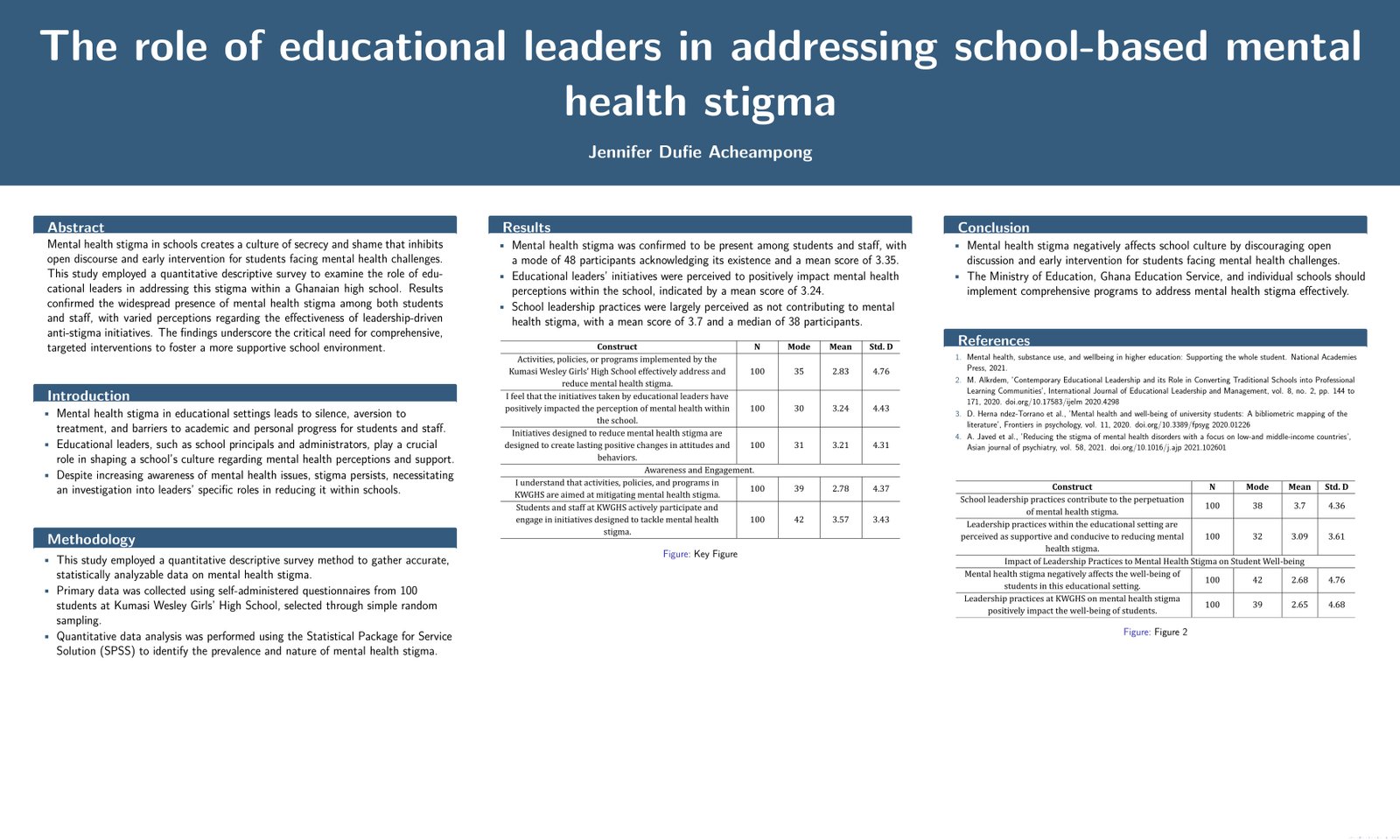
Background: Mental health stigma in schools creates a culture of secrecy and shame that inhibits open discourse and early intervention for students facing mental health challenges, positioning educational leadership as a potential lever for change. Objective: To examine the role of educational leaders in addressing school-based mental health stigma and to assess student and staff participation in stigma-reduction efforts. Methods: Quantitative descriptive survey study using primary data from a self-administered questionnaire and secondary data from books and publications. One hundred students from Kumasi Wesley Girls' High School, Ghana, were selected via simple random sampling; data were analyzed using SPSS. Results: Mental health stigma was confirmed to be present among both students and staff. Student and staff participation in leadership-driven anti-stigma efforts was found to be weak, with varied viewpoints on the extent of engagement. Conclusion: Mental health stigma negatively affects school culture by discouraging open discussion and early intervention. The Ministry of Education, Ghana Education Service, and individual schools should implement comprehensive.
Published
How to Cite
Issue
Section
Copyright (c) 2023 Jennifer Dufie Acheampong

This work is licensed under a Creative Commons Attribution 4.0 International License.