Role of salivary biomarkers in early detection of chronic kidney disease among hypertensive individuals
Keywords:
Chronic Kidney Disease, Hypertension, KIM-1, Cystatin C, Non-Invasive Diagnostics, Glomerular Filtration Rate.Abstract
Background: The prevalence of chronic kidney disease (CKD) is approximately 10% of the world population with hypertension being the second most significant contributor of CKD truly causing renal failure and diminishing renal function, which is a highly modifiable risk factor. Traditional diagnostic indicators (serum creatinine and estimated glomerular filtration rate (eGFR)) have some flaws in recognizing renal damage at an early stage.
Objective: To measure the diagnostic capability of salivary biomarkers in early CKD detection in hypertensive people.
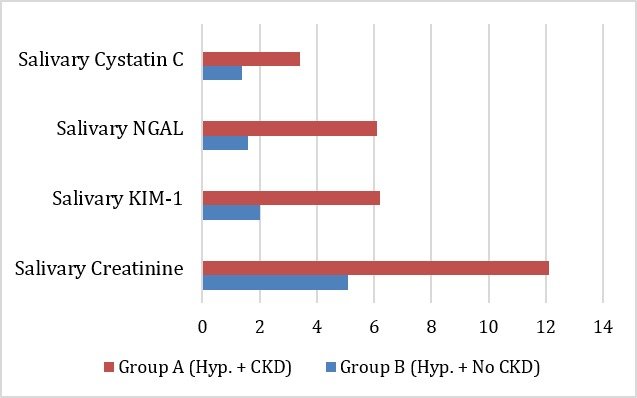
Methods: An analytical study was done on a cross-sectional analysis of 600 adult participants (Group A 200 hypertensive patients with CKD, Group B 200 hypertensive patients without CKD and Group C 200 normotensive controls). Salivary biomarkers of nine salivary proteins were studied: urea, creatinine, cystatin C, interleukin-18 (IL-18), neutrophil gelatinase-associated lipocalin (NGAL), kidney injury molecule-1 (KIM-1), beta-2 microglobulin, uric acid and alpha-amylase. One-way ANOVA and receiver operating characteristic (ROC) curve analysis was used in statistical analysis.
Results: The three groups were significantly different regarding all the biomarkers (p < 0.001). The salivary creatinine (AUC = 0.924), KIM-1 (AUC = 0.917), and NGAL (AUC = 0.908) had high diagnostic performance, as shown in the ROC analysis. An integrated biomarker panel (creatinine, KIM-1, NGAL, and cystatin C) was found to have the best diagnostic ability with AUC of 0.968, sensitivity of 93.5 and specificity of 95.0.
Conclusion: The salivary biomarker profiling holds a high potential as non-invasive screening method in recognizing early cases of CKD in hypertensive patients, and can be used in future point-of-care diagnostic methods.
Published
How to Cite
Issue
Section
Copyright (c) 2025 Ayesha Sara

This work is licensed under a Creative Commons Attribution 4.0 International License.