Supporting educators: exploring the role of counseling services in enhancing teachers' emotional wellbeing in selected schools in Kumasi Metro
Keywords:
Emotional Wellbeing, Counseling, Educators, Emotional Distress, Educator Support, School.Abstract
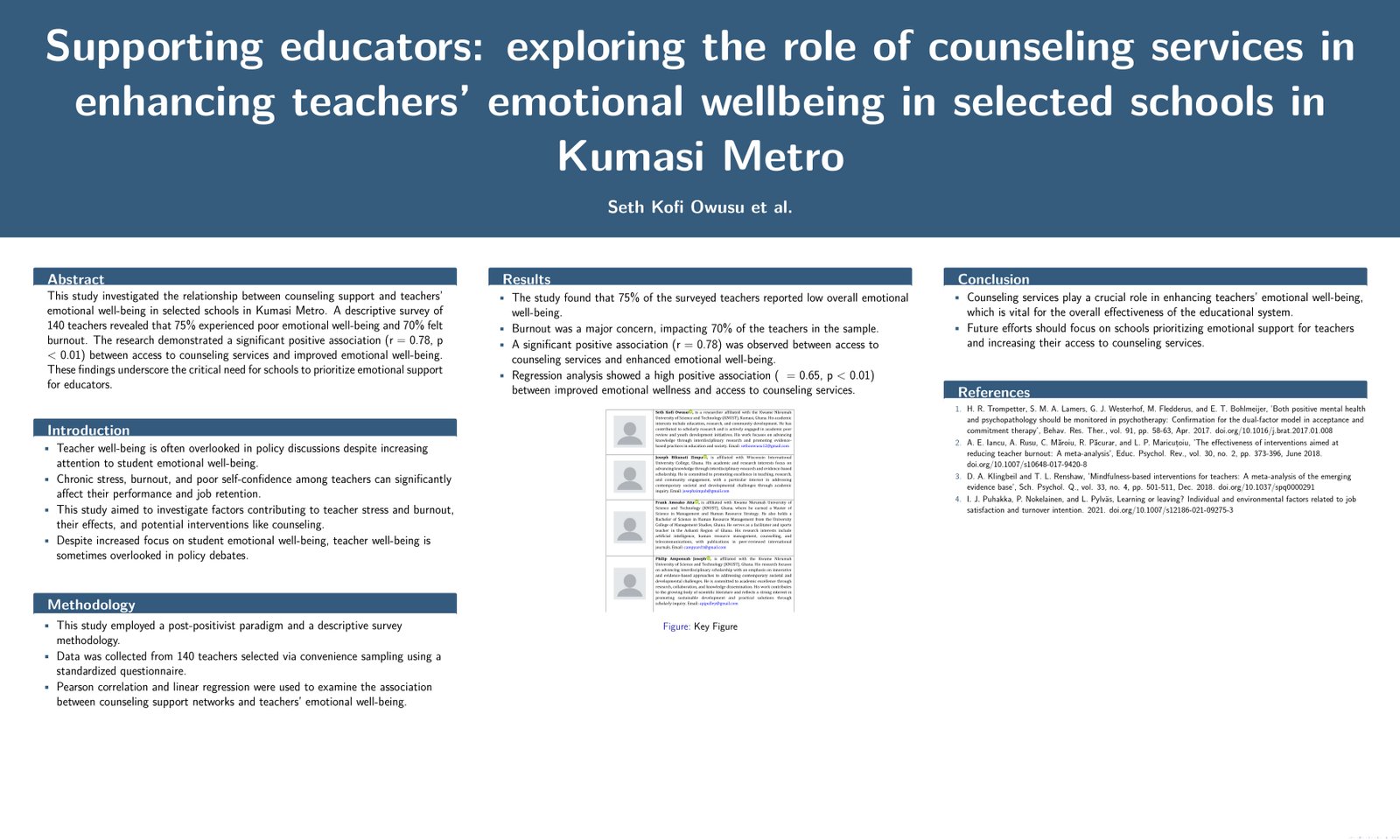
This study, which is based on a post-positivist perspective, uses statistical methods to investigate the relationship between counseling support networks and teachers' emotional well-being. The major research goal was to evaluate the influence of counseling services on teachers' emotional well-being and to determine the incidence of emotional distress and burnout among teachers. A descriptive survey approach was used to obtain data from 140 teachers selected from the Krejcie and Morgan table. A cross-sectional survey was used to assess teachers' emotional states as well as the impact of counseling services at a given moment. Convenience sampling enabled a diversified sample by gender, age, experience, and teaching location. A standardized questionnaire was used to collect data on demographics, emotional well-being, burnout, and the impact of counseling networks. The findings revealed an alarming degree of emotional suffering among teachers, with 75% having poor emotional well-being and 70% feeling burnout. The study demonstrated a substantial positive association (r = 0.78, p < 0.01) between access to counseling services and enhanced emotional well-being. These findings highlight the crucial need for schools to prioritize emotional support for teachers, stressing counseling's positive role in improving educators' well-being and overall effectiveness in the classroom.
Published
How to Cite
Issue
Section
Copyright (c) 2024 Seth Kofi Owusu, Joseph Bikunati Zimpa, Frank Amoako Atta, Philip Amponsah Joseph, Michael Gyan Darling

This work is licensed under a Creative Commons Attribution 4.0 International License.