XAI-driven clinical decision support framework for early detection of chronic diseases in smart healthcare
Keywords:
Clinical Decision Support, Chronic Disease, Smart Healthcare, SHAP, Counterfactual Explanation, Stacked Ensemble Learning.Abstract
Background: Chronic diseases diabetes mellitus, cardiovascular disease, and chronic kidney disease account for a substantial share of global morbidity and mortality. Early detection is critical to preventing long-term complications and reducing healthcare costs. Machine learning (ML) models offer strong predictive performance for chronic disease risk estimation but their black-box nature limits clinical adoption.
Objective: To develop and evaluate an Explainable Artificial Intelligence (XAI)-based Clinical Decision Support Framework for early detection of chronic diseases within a smart healthcare system.
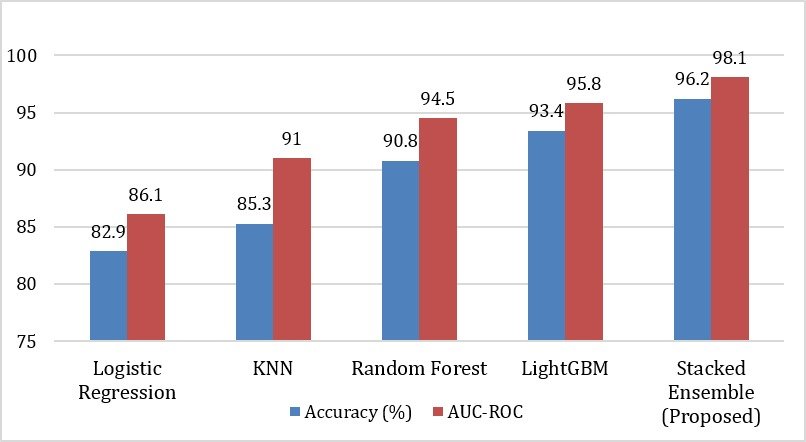
Methods: The proposed framework integrates Internet of Things (IoT)-based physiological data collection with a stacked ensemble classifier combining Random Forest and Light Gradient Boosting Machine (LightGBM) as base learners and Logistic Regression as a meta-learner. Dual-layer explainability was incorporated using SHapley Additive exPlanations (SHAP) for global model interpretability and counterfactual explanations for patient-specific, actionable guidance. The framework was validated on three benchmark chronic disease datasets, with performance assessed using accuracy, precision, recall, F1-score, and area under the receiver operating characteristic curve (AUC-ROC), and compared against individual baseline classifiers (logistic regression, k-nearest neighbors, Random Forest, LightGBM).
Results: The stacked ensemble model achieved a classification accuracy of 96.2% and an AUC-ROC of 0.981, outperforming all individual baseline classifiers. SHAP analysis identified HbA1c, serum creatinine, and systolic blood pressure as the most important predictors, consistent with established clinical guidelines. Counterfactual explanations provided clinicians with actionable, minimal-change recommendations to shift patients from high-risk to low-risk classifications.
Conclusion: The proposed XAI-based framework demonstrates high predictive accuracy alongside interpretable, clinically relevant outputs, supporting its potential as a reliable approach for integrating explainable ensemble-based predictive analytics into smart healthcare infrastructures for proactive chronic disease management.
Published
How to Cite
Issue
Section
Copyright (c) 2026 Abhijith Mohan

This work is licensed under a Creative Commons Attribution 4.0 International License.