Explainable artificial intelligence-based clinical decision support system for early disease diagnosis in smart healthcare
Keywords:
Smart Healthcare, SHAP, LIME, Disease Diagnosis, Machine Learning, XGBoost.Abstract
Background: Artificial Intelligence (AI) is transforming early disease detection, with rapid digitization of healthcare systems driving its widespread adoption in clinical practice. However, most machine learning and deep learning models remain black-box in nature, limiting acceptance within the medical community due to concerns over non-interpretability, lack of transparency, and insufficient trust.
Objective: To develop an Explainable Artificial Intelligence (XAI)-based Clinical Decision Support System (CDSS) for smart healthcare that enhances prediction transparency while assisting physicians in accurate, well-informed diagnostic decision-making.
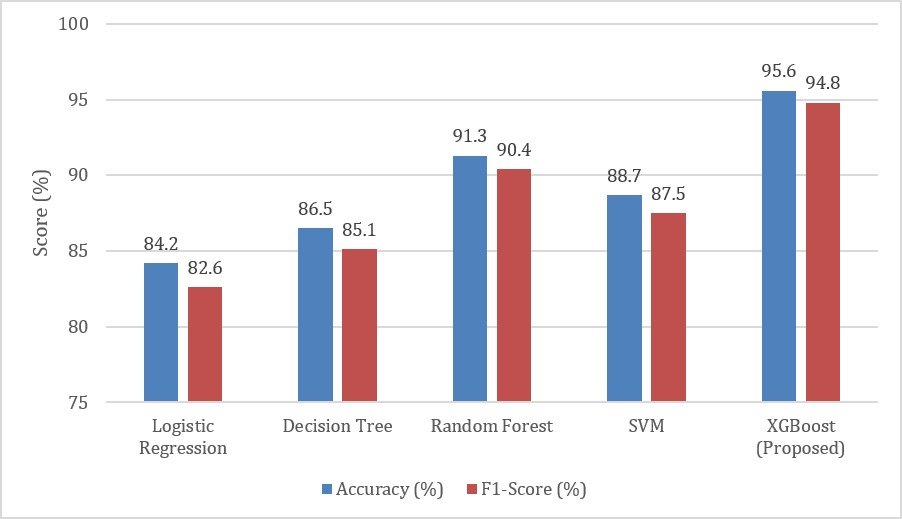
Methods: The system design integrates patient sensor data collected via Internet of Things (IoT) technology, comprehensive data pre-processing, and an XGBoost classifier for prediction. Explainability methods SHapley Additive exPlanations (SHAP) and Local Interpretable Model-agnostic Explanations (LIME) were incorporated to enhance model transparency and interpretability. The framework's performance was benchmarked against conventional classifiers, including Logistic Regression, Decision Trees, Support Vector Machines, and Random Forests. Clinician confidence in AI-assisted decision-making was also assessed following the introduction of explainability features.
Results: The proposed XGBoost-based model achieved a classification accuracy of 95.6%, outperforming all conventional baseline classifiers. Both SHAP and LIME explanations consistently identified blood glucose level, body mass index, and age as clinically meaningful predictors, aligning with established medical knowledge. The incorporation of explainability methods increased clinicians' confidence in model predictions by 27%, indicating that interpretable AI systems capable of conveying clear rationale can meaningfully enhance trust, accountability, and decision-making confidence.
Conclusion: The combination of high-performance predictive analytics with AI explainability methods effectively bridges the gap between model performance and clinical interpretability. This integrated approach supports the safe, transparent, and effective adoption of AI-based decision support systems within next-generation smart healthcare ecosystems.
Published
How to Cite
Issue
Section
Copyright (c) 2026 Dr. Priyadharshini. P

This work is licensed under a Creative Commons Attribution 4.0 International License.