Consumer behavior in the metaverse: the future of digital commerce and virtual economies
Keywords:
Metaverse, Consumer Behavior, Digital Commerce, Virtual Economy, Non-Fungible Tokens (NFTs), Avatar.Abstract
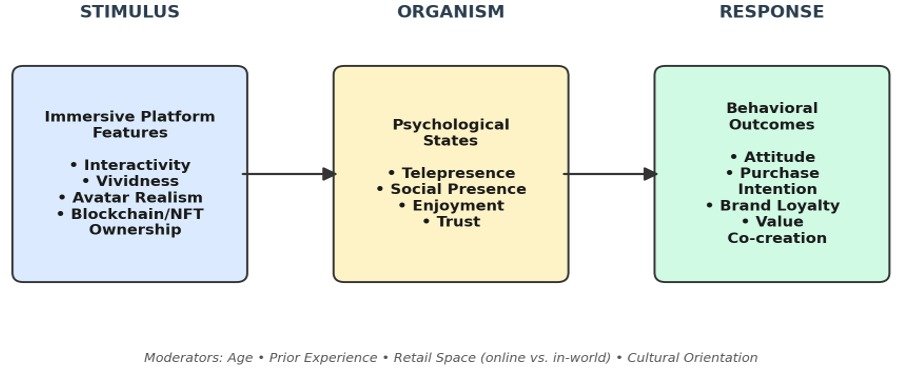
As a result, the metaverse, which is a virtual, 3D persistent environment that merges augmented reality (AR), virtual reality (VR), blockchain technology and digital commerce, has become a new frontier for digital commerce and virtual economies. This paper performs a systematic literature review to analyze the changes in consumer behavior in a metaverse-supported commercial context, and to map out to which psychological, technological and economic factors contribute to the purchase intention, brand engagement and value co-creation in virtual worlds. The review combines results of 20 peer-reviewed and recognized literature and industry articles published in the last four years (2022–2026) from the domains of marketing, information systems, blockchain, and tourism. Analysis shows that the variables of telepresence, interactivity, vividness and enjoyment are correlated with the consumer's immersion, and that avatar realism and identification have a significant impact on the emotional attachment and purchase behavior of the consumer. The ownership architecture facilitated by blockchain technology, especially the recently developed non-fungible token (NFT), is found to challenge the principles of digital scarcity, ownership and trust in virtual marketplaces, while significant issues such as regulatory fragmentation, platform interoperability and consumer protection remain unresolved. The study proposes a conceptual framework to connect the technological stimuli, psychological state and behavioral outcomes related to purchase in the metaverse, further accompanied by comparative overview of the major commerce enabled metaverse platforms and synthesis of the main drivers and barriers highlighted from the literature. Results indicate that brands which have been successful in virtual economies take a proactive approach to engagement that transcends novelty related engagement and encourages true social interaction, trust and perceived value. The paper concludes that, for digital commerce in the future, the key requirement will be to have interoperable, secure and consumer-centric virtual ecosystems, and provides directions for future empirical research, such as cross-cultural validation and longitudinal studies of consumer engagement in the metaverse over time.
Published
How to Cite
Issue
Section
Copyright (c) 2025 Sanjana Amarjeet

This work is licensed under a Creative Commons Attribution 4.0 International License.